Start with the decision, not the list
“Best software” hides an important question: best for whom, doing what, under which constraints? A solo writer launching a small publication and an organization migrating several departments do not need the same shortlist. Even when both need a website, their responsibilities, risks and available skills differ. A useful ranking identifies that scope before it names a winner.
Write a short decision statement before comparing products. Describe the task, the people who will maintain the tool, the information it will hold and the conditions that would rule it out. Separate mandatory requirements from preferences. An attractive interface cannot compensate for an unusable export route when retaining access to your records is essential.
Make criteria observable
Broad labels such as “easy,” “powerful” and “secure” are difficult to compare without definitions. Replace them with observable questions. Can a new editor publish a draft without administrator access? Can a departing user’s access be removed cleanly? Does an exported dataset retain relationships and attachments? These questions create a testable basis for comparison and reduce the influence of polished marketing.
Accessibility deserves the same discipline. The Web Content Accessibility Guidelines, WCAG 2.2, provide a reference for web accessibility, but a vendor mentioning the standard is not proof that every workflow is accessible. Check the relevant interface, keyboard behavior and documented limitations. Where your organization has legal or contractual obligations, obtain appropriate specialist advice.
“A score without an explanation compresses uncertainty instead of resolving it.”
Rankroverradarp editorial note
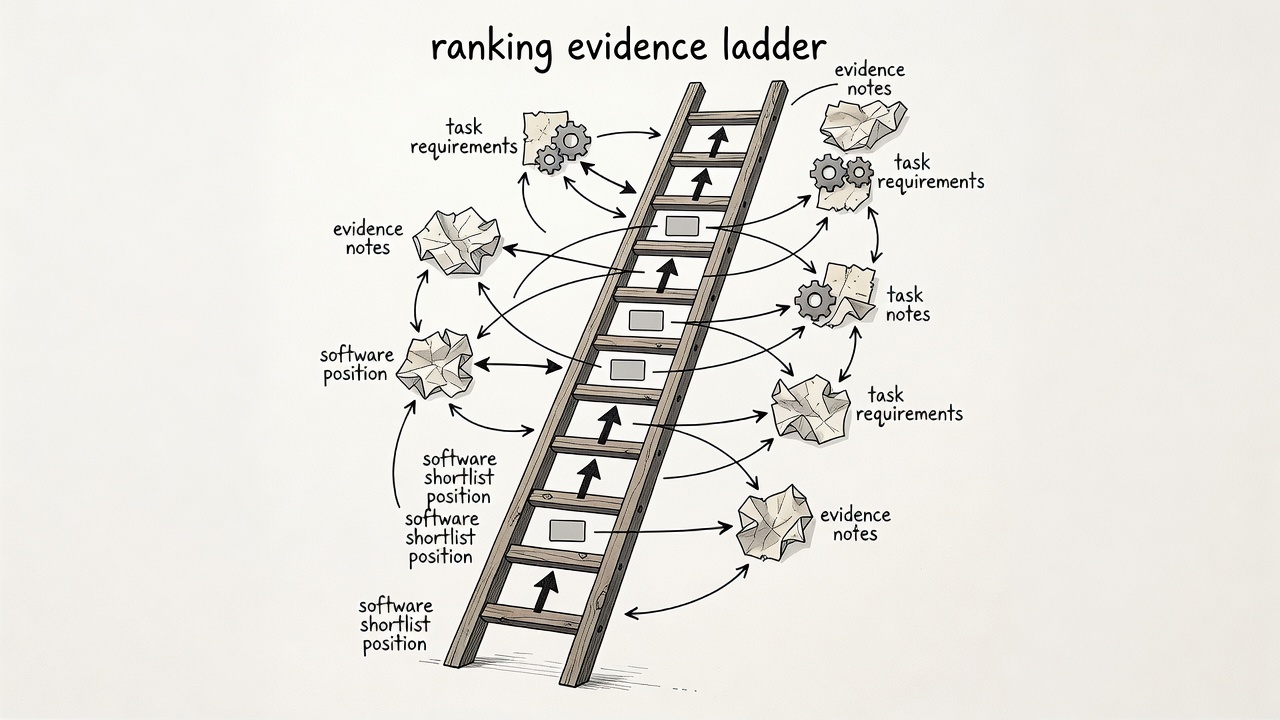
Distinguish evidence from inference
Official documentation can establish that a feature is described and identify stated conditions. It cannot establish how smoothly that feature works in your environment. A hands-on trial can expose friction, but its findings remain limited to the account, configuration, devices and tasks used. A community report can reveal a worthwhile question, but it does not establish frequency across all customers.
Keep these evidence types separate in your notes. Record the source URL, the relevant plan or version when available, and the date you checked it. Label an unanswered question as unknown rather than treating the absence of a complaint as evidence of quality. This dossier supplies a method; it does not claim that we have completed independent product benchmarks.
Compare the trade-offs that matter
The following matrix is a template for evaluating a shortlist. It deliberately avoids product scores: the same trade-off can be helpful in one setting and unacceptable in another.
| Criterion | Evidence to collect | Reason it changes the decision |
|---|---|---|
| Core task fit | A completed representative task | Separates advertised capability from usable workflow |
| Access control | Role and permission behavior | Shows who can view, edit and administer information |
| Portability | Sample export and reconstruction attempt | Reveals the practical cost of leaving |
| Operating effort | Setup and maintenance notes | Exposes costs beyond the subscription |
| Commercial fit | Current provider terms and plan limits | Checks whether the viable configuration fits the budget |
Use weighting without false precision
If you choose to score candidates, decide the weights before reviewing the results. Otherwise, it is easy to adjust the model until a preferred brand wins. Describe why a criterion matters, and retain the underlying observations beside the score. Avoid decimal-level precision when the evidence is a short trial or a subjective judgment.
Test how sensitive the outcome is to your assumptions. If a small change in the importance of reporting reverses the order, you do not have a decisive winner. You have a close choice that needs a clearer requirement or a better trial. Presenting a tie or a conditional recommendation is more honest than forcing a dramatic podium.
Publish reasons and revision triggers
A responsible shortlist explains both inclusion and exclusion. A tool may be a strong candidate for an experienced administrator but inappropriate for a team without maintenance capacity. WordPress, Webflow and Squarespace illustrate different publishing approaches; their names alone do not determine their suitability. Consult their current documentation before relying on a specific capability.
Finally, state what could change the decision: a revised export format, a new permission requirement, a different team size or an altered contract. Rankings are snapshots of a decision model, not permanent properties of products. Keep your notes so that a future review can revisit the reasoning rather than starting again with someone else’s top ten.