This directory is a navigational starting point, not a complete market survey. Entries are grouped by purpose and appear without scores or paid positioning. A service’s inclusion means it illustrates a useful category or trade-off; it does not mean we have verified every feature, reviewed its current contract or tested its latest release.
Follow the official links to investigate current capabilities, plan conditions and support arrangements. Product categories overlap, so use the descriptions to ask better questions rather than to draw rigid boundaries. If your requirements do not fit a category neatly, identify the primary task first and evaluate any secondary workflow separately.
Publishing: who owns the upkeep?
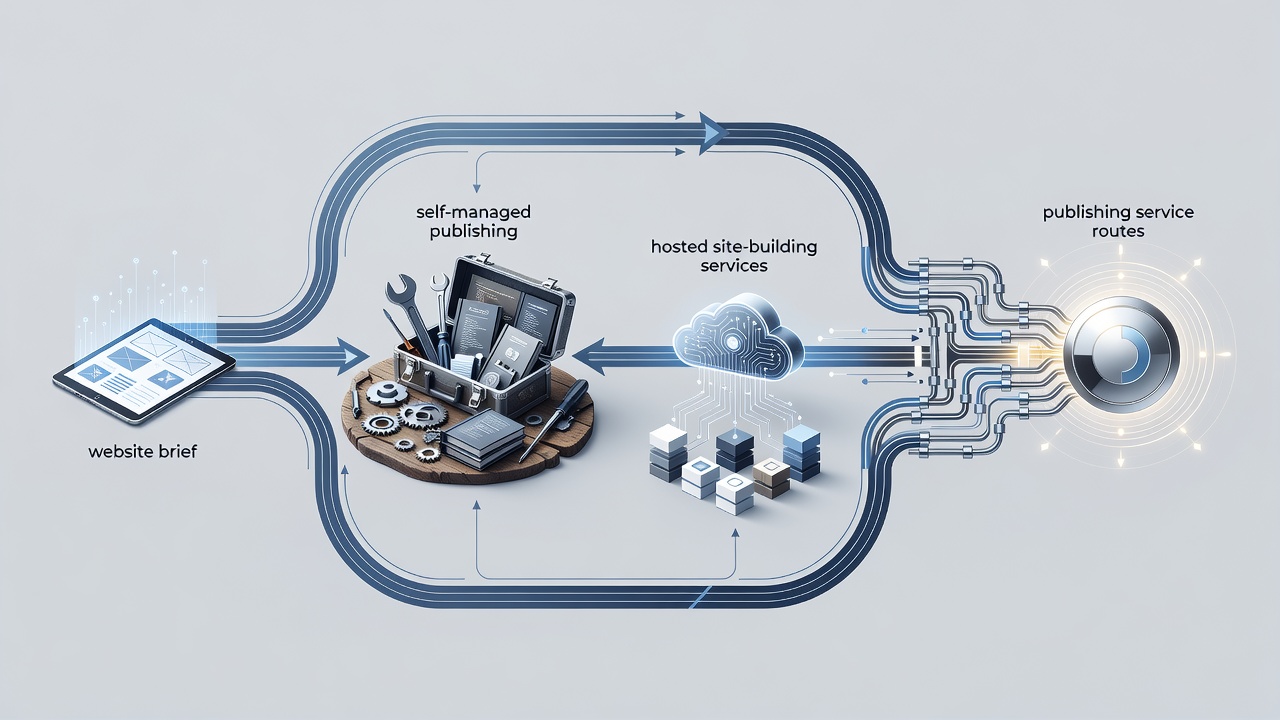
WordPress is an open-source publishing system that can be used with independently chosen hosting. It is worth investigating when control over extensions and deployment matters. Ask who will maintain updates, choose plugins, manage backups and respond to problems. Distinguish the software project from particular hosting companies and managed services built around it.
Webflow and Squarespace are hosted website-building routes with different design and publishing workflows. Investigate them when a managed environment fits your operating model. Check current content limits, accessibility responsibilities, export behavior and any functionality that depends on a particular plan. A managed service reduces some responsibilities without removing the need for content governance.
Coordination: documents, tasks or records?
Notion is a candidate when your work connects documentation with database-style organization. Trello provides a board-centered approach to tracking tasks. Airtable offers a structured-record approach with views and workflow capabilities. These are different starting models, even where their feature sets overlap.
Choose a representative activity before comparing them: maintaining a project brief, moving a task through approval, or updating an inventory. Look at the relationship between people and information. A tool that makes records easy to structure may still require careful permission design. A simple board may fit a task sequence while leaving detailed documentation elsewhere.
Google Workspace and Microsoft 365 are broader productivity environments. Existing identity, document and administration practices can matter more than an isolated feature advantage. Avoid importing the same information into several tools until you know which one is the authoritative source.
Measurement: useful questions before more data
Matomo, Plausible and Google Analytics are examples of website measurement services with different operating and reporting approaches. Their inclusion is not a privacy certification or a legal recommendation. Review the deployment model, collected information, retention settings and applicable terms for the actual configuration you intend to use.
Begin with a question that could change a decision. Perhaps you need to know whether readers reach a guide from a directory entry, or whether a publication has broken navigation. Collecting additional events without a purpose adds interpretation and governance work. This website does not install these services; they are directory references only.
Design and technical work: inspect the handoff
Figma is a route for interface design and collaborative design workflows. Canva provides a route for producing visual materials from a broad editing environment. Compare output requirements, accessibility checks, reusable components and licensing conditions, rather than assuming that a polished preview is ready for every destination.
For development collaboration, investigate GitHub and GitLab against your repository, review and deployment needs. A familiar product name does not remove the need to assess permissions, secret handling and operating effort. If you are evaluating structured workflows rather than code, n8n is another category example to investigate, with special attention to credentials and failure handling.
“A directory should help you navigate the market, not pretend the market has one destination.”
Rankroverradarp editorial principle
Leave with a small shortlist
Select a few plausible candidates, not every service mentioned here. Record why each deserves a trial and what would disqualify it. Confirm current plan details directly with providers; this directory intentionally avoids prices that could become misleading when plans change. For consequential procurement, ask the provider for the commitments you actually need rather than relying on a category description.
Our editorial framework explains how to separate documentation from practical observations. The next useful action is to complete the same small task in each candidate, then compare the evidence. If you believe a category is missing, prepare a suggestion explaining the task, the proposed service and why its approach is meaningfully different.